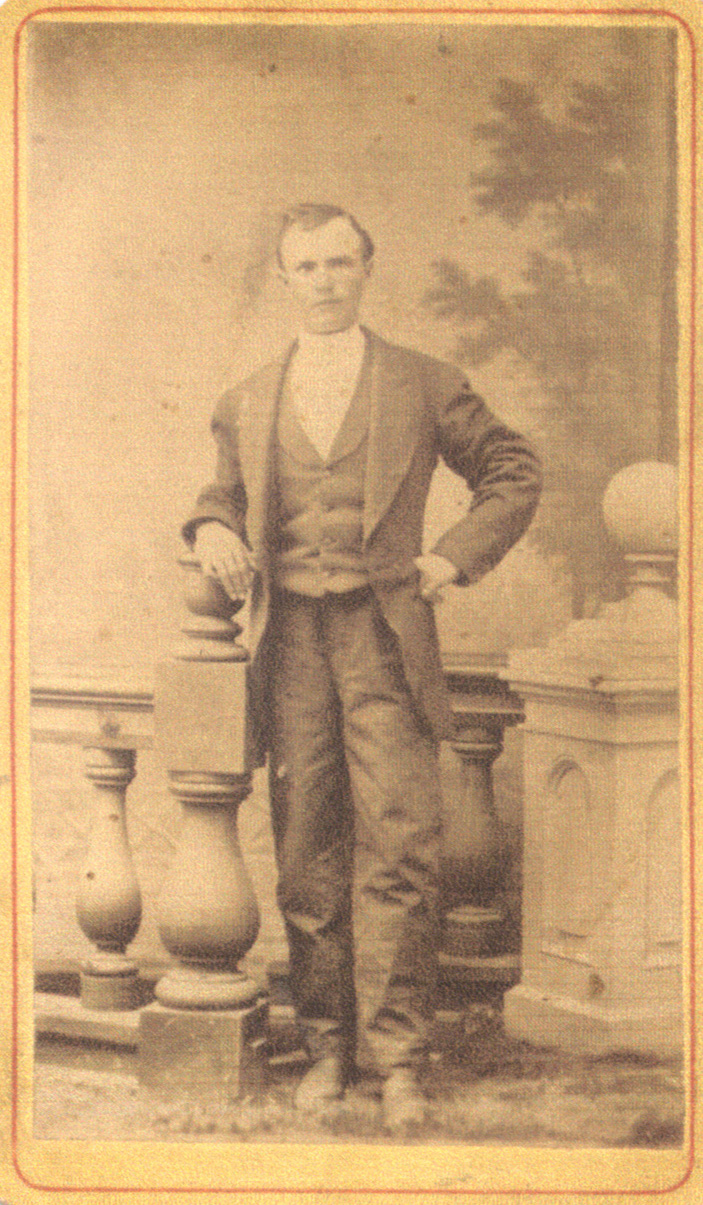
There was renewed joy and happiness in William Alder's home at Trowbridge, Wiltshire, England on May 3, 1824. The cause for this great rejoicing was that Elizabeth, beloved wife of William, had given birth to their sixth child. The child was named Alfred. He was the fourth son to be born to this couple. How much more it would have added to their happiness if they could have drawn open the curtain of the future and seen what it held in store for this little bundle from heaven. They could have seen that he was destined to cross an ocean, become a builder, a mechanical engineer, and a great religious teacher in far away Western America.
Alfred received his early education and training in Trowbridge, the place of his birth. After receiving his book learning such as the three R's, he specialized in Mechanical Engineering. His Mechanical Engineering consisted of a complete knowledge of the blacksmith trade. He was not only trained to do repairs but also to smelt iron and temper steel. He was next trained as a machinist and given knowledge of making tools, gears, and all kinds of parts for machines and engines. He was then taught how to assemble engines. The engines were brought to him knocked down and he had to assemble them and put them in running order. He was also taught how to make parts and build a complete engine. This education and training completed through study and apprenticeship training; he was well equipped to make a living.
When Alfred was a young man, his father and mother moved to Chaltenham, Gloucestershire, England. Here his father worked at his trade as a carpenter and his mother opened and operated a boarding house. Alfred also found work at the trade for which he had been trained. He first obtained work in a cutlery factory. His first duty was tempering steel for the blades of the knives, and then he was finally put in the finishing department. While thus working at his trade in the city, he met two Mormon Elders who told him of the restoration of the Gospel of Jesus Christ; how the heavens had again been opened and that God had spoken to the boy Prophet Joseph Smith.
From the first time that Alfred heard the glorious message of the restoration of the Gospel, he was impressed that it was the truth. He immediately began a careful and prayerful consideration of it. He set himself to studying tracts and other literature that the missionaries left with him, and to comparing them with the scriptures. As a result of this prayerful study, he soon became converted to the Gospel, and in a short time thereafter, on the 9th of November 1841, he was baptized by Charles Phelps and was confirmed the same day by Henry Webb. So far as the records show he was the first male member of the Alder family to be baptized into the Church. From the moment that he was baptized, he was imbued with a desire to come to Zion and be with the Saints of God. In keeping with this desire to join the main body of the Church, he began to plan and save money for the trip. He gave up his work in the cutlery factory and found work in a machine shop and engine assembling plant. This plant specialized in fishing and river boat engines. Here he received much higher wages, nearly double what he previously had received, and it gave him the chance that he had always wanted to work with machinery. He loved machine work and to assemble engines and to run them. He, therefore, not only received more money from which he could save for his trip to Zion, but it gave him a training for what his future life would call for. In the spring of 1844 Alfred's dream of leaving for Zion came true. (This dream would have been realized two years sooner but his father became ill and died.) On March 5, 1844 he set sail from Liverpool for the United States on the ship Glassco. He, with the other Saints, was a little over five weeks on the ocean before they landed at New Orleans.
Alfred stayed for a short time at New Orleans and obtained work only long enough to secure sufficient money to continue his journey to Nauvoo. While at Nauvoo, he met the Prophet Joseph Smith and had a number of talks with him. On one occasion he asked the Prophet a question regarding the tragic death of one of his friends. He explained to the Prophet that his friend was a good man yet had been horribly mangled when caught in the machinery of an engine. Alfred wished to know why such a good man should meet death in this tragic manner and what would be the condition of his mangled body in the resurrection.
The Prophet explained that the greatest work of the spirit after leaving the body was to prepare the body for a glorious resurrection. All the defects would be repaired and everything that had caused death would be removed. The resurrection would be a matter of knowledge. Any good man holding the Priesthood had the right to this knowledge because he held the keys to have the heavens opened up to him and to receive the answer to all mysteries, to commune with the general assembly and the Church of the First Born, and to enjoy the communion and presence of God the Father and Jesus Christ, the mediator of the new covenant. Naturally one of the first things he would like to receive would be knowledge of the resurrection. The Father and the Savior know all about the resurrection. The Savior said when He was here upon earth, "I have power to lay my body down and take it up again." He had seen His Father do it, for he bore testimony while in life. He said, "I do nothing save what I have seen my Father do." When the good man who holds the Priesthood receives a knowledge of the resurrection, many who do not hold the Priesthood will ask him to assist them in the raising of their bodies. So anxious will they be to have their bodies resurrected they will agree to be his servants forever, thus fulfilling the scriptures which say, "If thou art faithful in a few things, thou shalt be ruler over many."
Alfred also had the privilege of hearing the Prophet deliver his last sermon from the top of the temple. He heard the Prophet tell of the great trouble that would come upon the nations of the earth unless they repented and served the true and living God.
Alfred was at Nauvoo when Joseph and Hyrum were martyred at Carthage, Illinois. When their bodies were brought back to Nauvoo, he assisted in guarding them. He purchased the gun that had belonged to the Prophet, from his family, as a momento. He was also present when Brigham Young called the saints together to vote on who should lead the church, and he was a witness who saw the mantle of the Prophet fall upon Brigham Young. He voted with the majority of the Saints that the Quorum of the Twelve should guide the Church until a new First Presidency could be sustained. Alfred said that he watched Brigham Young as he spoke and he, like everyone else, thought it was the Prophet Joseph who had come back to speak to them. Brigham Young looked so much like Joseph that even a broken tooth that the Prophet had in life was plainly visible.
After the death of the Prophet, Alfred remained in Nauvoo during the summer working at his trade as a machinist. In the fall he went to Cincinnati, Ohio, and there he was employed in a machine shop for a few months. In the fall of 1845 he became an engineer of a steamboat on the Ohio River. The boat was engaged in the cotton trade. He continued at this work until he learned that the Saints were leaving Nauvoo to go west. He then returned to Nauvoo to assist in the repair of wagons, etc. to make the journey westward. While traveling with the Saints, he first stopped at Mount Piska and later joined them at their Winter Quarters near Omaha, Nebraska, now know as Florence, Nebraska.
Alfred intended to continue his journey westward with the Saints. He would have arrived with the first company in Salt Lake Valley if it had not been for a call from Brigham Young to go with others back to St. Louis to be of assistance to the Saints in that locality and those coming from the British Isles.
Alfred was very small in stature and this saved him from going with the Mormon Battalion. Before leaving from St. Louis, he received a patriarchal blessing under the hands of John Smith. This blessing was a comfort and a guide to him throughout his life. It was given to him at Winter Quarters on the 26th day of April 1847. Alfred's being called to St. Louis served a double purpose, that of assisting the Saints who were living in the locality and those that might come from afar. It also served the purpose of his being able to earn means to assist in bringing his mother, brothers, and sisters from England to America. The men whom Brigham Young called to return to St. Louis were especially those who had had experience in running boats so that the Saints would have a greater safety in being brought up the river.
At St. Louis Alfred first obtained work at running a stationary engine. He was able to get this job because of his ability to adjust the governor and make the engine run. His next job was running a steamboat on the Mississippi River from St. Louis to New Orleans. The boat was counted a slow one but through Alfred's mechanical ability, he was able to step it up until it could beat any boat on the river; although to do so, at times it would melt the solder on the smoke stacks.
While living at St. Louis, Alfred met and married Susan Field, a daughter of William and Susan Rouke Field. They were married on the 26th of March 1848.
Susan Field was born February 27, 1832 at Morin Lane, Chaltenham, Gloucestershire, England. She lived with her parents until her father died. Then her mother placed her in an orphanage. While the institution in which Susan was placed was called an orphanage, it was in reality a training school for girls. They were taught to cook and sew and do all kinds of fancy work. They were trained to take positions in the more well-to-do families after they had served their apprenticeship. Susan was nine years old at the time she entered the school and she remained there until she was twelve years old, at which time her mother joined the Church of Jesus Christ of Latter-day Saints and decided to come to America. Susan's mother took her out of the orphanage and brought her to Nauvoo. It took some carefully planned effort on the part of Susan's mother to get Susan released from the orphanage, because when a girl was once placed in this school, she was supposed to remain there until she was ready to take a position in a home. Susan's mother asked to take her home for a week's visit and while she was making this visit, her mother got her on the ship and off to America. The officers learned of the plan to take Susan to America, but by the time they arrived at the dock, the ship was just pulling out. Susan's mother had arranged for her passport and although the officers tried to stop the ship, they could not do it.
Susan was baptized into the Church of Jesus Christ of Latter-day Saints in 1844 by William Williams. The records do not give the day of the month nor the place, and it would lead us to believe that she was baptized after she came to America.
On the 27th day of April, two weeks after Susan and her mother arrived at Nauvoo, Susan went to live with the parents of President John Taylor on a farm about 20 miles from Nauvoo. She was living with them at the time that Joseph and Hyrum were martyred.
When the Taylors learned that their son, John, had been wounded, they immediately hitched up their team and started for Nauvoo, leaving Susan there to take care of the place with just a small neighbor girl to keep her company. It was quite a responsibility for a girl to be left alone when there was so much danger of mobs. During the night the girls became very frightened because of the strange noises which they heard. The noises proved to be only the cattle rubbing themselves on the logs of the house and sticking their horns between the logs. This made the girls think that it was members of the mob, and as the horns would protrude through, they thought it was guns being pointed at them and that they would be shot at any moment.
Although Susan was well trained as a cook at the school where she had attended, it did not prepare her for this wild frontier life. While cooking at the Taylor home in the open fireplace, she had the misfortune of having her apron catch on fire. It was only because of quickness on her part that she was able to get it off before all her clothing caught on fire and save herself from being badly burned. However, the sparks from the fireplace fell on her other clothing and burned many holes in them; therefore, during her six weeks stay at the Taylor home she almost completely ruined all her dresses. She had to use her mending training to put them to repair.
Shortly after the death of the Prophet Joseph and his brother, Hyrum, Susan moved to St. Louis to help her mother in the bakery. Although Alfred Alder lived in the same town in England as did Susan at the time he joined the Church, and according to the records, came to America on the same ship, they did not become personally acquainted with each other until they met in St. Louis.
After the marriage of Alfred and Susan, they made their home in St. Louis until the spring of 1853, during which time three children were born to them. Elijah was born November 26, 1849; Alfred William, March 13, 1851; and John Field, October 13, 1852. In the spring of 1851 Alfred went to Alton, Illinois where he became the engineer of a stationary engine. He held this position for nearly one year and then returned to his home in St. Louis. His brother, John, died of cholera on the 23rd of July 1852 at St. Louis.
Now that Susan had to face the problems of taking care of a family, she found that all the things she had learned in her training were very helpful to her, especially the art of sewing. She was a good seamstress and sewed all the children's clothes, knitted socks for all the members of the family and made all the shirts for her husband.
In the spring of 1853, Alfred and his family joined a party in crossing the plains for Salt Lake Valley under the leadership of Claude V. Spencer. This was an ox team company consisting of two hundred and twenty-two members. Their equipment consisted of 231 oxen, 48 wagons, 1 mule, 28 cows, 6 heifers, 12 horses, and 2 carriages. Two of the wagons belonged to Alfred, one of which was driven by his brother. Alfred equipped one of his wagons with a measuring device with which to measure the distance traveled each day and also the distance to the Salt Lake Valley. This device was one of his own construction. During the trip across the plains, Alfred was again called upon to use his mechanical ability to keep the wagons of the company in repair. Many times he was as much as a whole day behind the other members of the company because of some good brother needing his help to repair his wagon. Claude V. Spencer's company made very good time in crossing the plains. They arrived in Salt Lake Valley on September 23, 1853.
Alfred remained in Salt Lake City during the winter. In the ensuing spring, in the month of May, he moved with his family to Kaysville, Davis County Utah. Here he opened a blacksmith shop and set to work to build a home. He had to redouble his efforts because of the great task that he had undertaken. He made the molds and made the adobes with which to build the house for his family. He built in the home every modern convenience known to them at the time, and he made a large living room to accommodate the company that might come. His wife, Susan, said that it was the most convenient and comfortable home that she had ever lived in. In order to run his blacksmith shop, Alfred had to go with his cousin, Shem Purnell, to the mountains and burn large pits of charcoal. He had great trouble in getting the needed iron with which to work. Once he walked to Iron County, selected his iron, bought a team and wagon, brought the iron back and smelted the iron so he could have it to work with in his shop. He was an expert at tempering steel and preparing the iron for anything that he wished to make. In his shop he built everything from household necessities to all kinds of farm implements. He even built a threshing machine, which was one of the first, if not the first, to be built in the state. Because of the lack of machine tools with which to work, he had to cut out all the cogs, including the master wheel of the horsepower, with a coal chisel. This he did with definite accuracy. He also built many wagons, and one spring he built thirteen sulky plows. Alfred did his full part in helping to reclaim this barren desert and make it productive. Truly he was one of those whom the Prophet referred to when he said, "The wilderness and the solitary place shall be glad for them; and the desert shall rejoice, and blossom as the rose. It shall blossom abundantly, and rejoice even with joy and singing; the glory of Lebanon shall be given unto it, the excellency of Carmel and Sharon, that shall see the glory of the Lord and the excellency of our God." This could not have been accomplished if it had not been for the help from the God of Heaven. The Prophet seeing this said, "Strengthen then ye the weak hands and confirm the feeble knees."
It was no easy task to change this barren waste into a fertile garden and fields. If there ever was a dry parched spot of desert, it was these sand ridges of Davis County; but through the combined efforts of faithful and hardworking saints (as was Alfred), it is today one of the greatest garden spots of the West, if not the entire world. This again fulfilled the words of the Prophet. "For in the wilderness shall waters break out, and streams in the desert. All the parched ground shall become a pool, and the thirsty land springs of water." With the united effort of the Saints, aided by God's trough with his majestic hand, the sayings of the Prophet were literally fulfilled.
Those were dark and dreary days. Fuel was scarce and the first winter Alfred had to carry willows from the nearby streams for fuel. Men would hopefully plant their crops only to see them destroyed by the grasshoppers. Many are the times that the Saints have hunted all day to find enough pig weeds to have a small mess of greens for supper. It took great courage and faith to endure such trials and hardships. The grasshoppers were so thick that they would form a cloud that would hide the sun, and they would eat everything that was green and not covered. To get a small sack of flour, even though it was barley flour, was a great luxury. It took men and women with great courage to face such problems; but they were made of that kind of stuff. Most people would have given up and left the place but not so with these God fearing people. They were full of faith and knew if they were faithful, God would hear them. God did come to their rescue -- he heard and answered their prayers. How often this good man, Alfred, on his bent knees thanked God for the blessings of these everlasting hills. With the poet he could say: "For the strength of the hills we bless thee, Our God, our father's God; Thou hast made thy children mighty by the touch of the mountain sod; Thou hast let thy chosen Israel to freedoms last abode. For the strength of the hills we bless thee, Our God, our father's God. Thou hast led us here in safety, where the mountain bulwark stands; For the rock and for the river, the valley's fertile sod; For the Strength of the hills we bless thee, Our God, our father's God."
Although Alfred was kept very busy working at his trade, even to fixing sewing machines, he never allowed it to interfere with his religious duties. Many times he walked from Kaysville to Salt Lake City and returned to attend conference and the School of the Prophets. He often wondered why, when he had tried to live his religion and had worked so hard to try to be helpful in building up the community in which he lived, he was not blessed with more of this world's goods. He was not poor, yet many of his friends had become very prosperous and he could not see that they had put forth any greater effort than he had. He wondered if he had been too easy and allowed too many of the people to pay him for his work by just saying "Thank you." He knew that he had been busy all the time and had tried to help all who came to him but he was a very poor collector.
One day while walking past the tabernacle, a little breeze blew a small piece of paper in front of him. He picked it up and read a statement from one of Brigham Young's sermons, "The reason why the Lord keeps some people poor is so that they will be humble and not apostatize from the church." Alfred never allowed his humble circumstances to worry him again.
On October 21, 1855 in the endowment house in Salt Lake City, Alfred and Susan received their endowments and were sealed the same day for time and all eternity.
When Johnson's army was on their way to Utah in 1857, Alfred was called to go with other men to meet them in Echo Canyon. When the Saints moved south, he and his family went with them.
During Alfred's and Susan's stay at Kaysville they had three children born to them. Susan May, born February 3, 1855; Theodore Daniel, born September 17, 1857 and Clara Jenette born December 13, 1859.
On one occasion while Alfred was living at Kaysville, Brigham Young stopped there for the night. He called a few of the brethren into a cottage meeting. One of the men had recently returned from a mission to the East. President Young asked this brother regarding the Prophet Joseph's family. He asked particularly about David and the brother told him David was a big beardless boy. President Young said this is just what he expected. President Young further said he wished the Prophet's family would stop their fighting and come and be united with the Church: that because of their fighting the truth, the Lord had dealt with them as He said He would. The Lord had said the prophet's family must need repent and forsake some things and give more earnest heed unto the Prophet's sayings, or they would be removed out of their place. The Lord was allowing them to have their free agency. Because of the great work the Prophet had done in establishing the Gospel, God would take them from the earth before He would allow the Prophet's family to go so far as to commit the unpardonable sin and lose all chance of their salvation.
President Young then stated that there was great wealth stored in the mountains of Utah; but the world knew nothing about it. Some day it would all be discovered and this would become a very wealthy and important state. "Why," said he, "I could stand in this door and show you where you could pile up gold by the ton. Much of it could be found not more than four feet under the ground; but it would destroy the people of this church before they became established. Some of this gold will be discovered and be used to pave the streets of Jackson County, Missouri."
In the spring of 1859, Alfred, with a small group of men, made a tour of inspection through Cache Valley, passing through Logan (which was then but a small settlement with a few houses) and coming on to the present sight of Franklin, Idaho. There were no settlers at Franklin at that time. In the spring of 1860 he went to Franklin with a few of the first company of settlers, this being the first town to be settled in Idaho. He also moved his family there. In Franklin, Alfred and his cousin, Shem Purnell, built a blacksmith shop. It was the first business house to be built in Idaho and he again began working at his profession. He made a trip or two to Kaysville to work on the threshing machine which he had built. The Saints depended upon him to keep the machine in repair. However, he maintained his home in Franklin until 1863. While living at Franklin, Alfred and Susan had one child born to them - Elizabeth Jane born November 16, 1862. During the time that Alfred and his family lived at Franklin the Indians were very troublesome and it finally resulted in what is known as the Battle Creek War. This war between the Indians and the soldiers was under the command of Colonel Connor from Fort Douglas, Utah.
Alfred and his family moved back to Kaysville, Utah in 1863 where he again worked at his trade. During the next ten years of their lives at Kaysville, Alfred's and Susan's home was blessed with five children. Margaret Ann was born August 10, 1864; Augusta Ulyard, August 27, 1866; Ella Field, November 2, 1868; Edgar Field, February 24, 1871; and Jessie George, September 23, 1873. It will be noted that Jessie George, Alfred's and Susan's twelfth child was born on the twentieth anniversary of their entrance into the Salt Lake Valley and at about the same hour. Alfred as usual was called upon to do almost everything from fixing of sewing machines, farm implements, and even to repairing clocks. People seemed to think that he could do anything. One of his friends, William Blood, had a child born with his foot turned almost backwards, and Alfred was called upon to make a brace to straighten the foot. This he did and it was successful. Once when another one of his friends broke his jaw, Alfred was called upon to make a silver brace to hold the jaw bone in place while it healed. This was also a success.
Alfred wrote a very fine hand, as one can see from anything that he wrote whether it is his accounts kept in his shop from day to day or an important document. Because of his fine penmanship, he was called upon to write the copy for the school children as a guide for them to learn to write a good hand.
In the spring of 1881, Alfred was called to go on a mission to England, his native land. Although he had very little means, he willingly accepted the call. It was quite a struggle for his family, because he left them very little to get along on. He was set apart for his mission on April 7, 1881 and he returned in 1883. The Church records do not give the date of his return. It was his privilege while on his mission to preach the gospel to many people, some who were members of the Royal Family. The Rallison family was one that heard the Gospel for the first time from his preaching. This family later joined the Church and came to Utah, first settling in Davis County, Utah and finally settling in Preston, Idaho where they still live.
Another person whom Alfred met while traveling as a missionary was Mereina Warr. She came to Utah and she and Alfred were married on August 30, 1883. Mereina was a daughter of James and Ann Russ Warr. She was born on the 23rd of April 1861 at Milton, Clavdown, Somersetshire, England. She received her endowments in the endowment house on August 30, 1883; and she and Alfred were sealed the same day for time and all eternity. In the spring of 1884 Mereina moved to Preston, Idaho and on March 19, 1885 a daughter was born to her and Alfred. They named her Alice Warr Alder.
In June of 1885 Alfred and Susan moved with their family to Preston, Idaho where he purchased a farm about 2 1⁄2 miles southeast of the town. He worked some at his trade, first in the shop of his son, Alfred William, and later in a shop on his own farm. He also worked on his farm. He always attended religious duties, and he was the senior member of the High Council of the Oneida Stake of Zion for a number of years.
Alfred Alder lived a long and useful life. He believed in giving his family all the comforts that he could afford. He bought his wife, Susan, one of the first sewing machines that ever came to the state of Utah. A sewing machine was a great luxury at that time. Though not wealthy, he drove one of the finest buggies, and in 1892 he built the nicest home at the time in Preston. The blessing that he received at the hands of John Smith was literally fulfilled except for one statement which said that he would preside over groups of Lamanites. He often wondered about it, but shortly after his death six of his grandchildren married Lamanites. From these marriages there are six large groups of children over which he will preside in the eternal world. Susan and Alfred had twelve children, seven of which reached maturity and raised families. Mereina, his second wife, and one child who also grew to maturity and had a large family, Alfred's posterity today, living and dead, number over a thousand souls; thus is being fulfilled his blessing that he should have a numerous posterity.
Alfred Alder was always earnestly and intelligently in favor of progress and development along health, and enduring lines, and he was willing to lend a hand to secure them in every proper way. He was an influential and active force in building up the communities in which he lived. Alfred died February 19, 1905 being 80 years, 9 months and 16 days old. He lived a long, useful and full life, and he left an untarnished name of which his posterity can well be proud. The last survivor of his family was Margaret Ann. She died April 1955 at the age of 90. She had the pleasure of filling two missions with her husband to Norway.
NOTE: Some sentence structure and spelling corrections were made in retyping this history of Alfred Alder.
Meridee Bodily Hatch 31 July 2003
Always earnestly and intelligently in favor of progress and development along healthy and entluring lines and willing to lend a hand to securing them in every proper way, Alfred Alder, of Preston, Idaho, has been an influential and active force in building.up the communities in which he has lived in the Northwest. and in contributing to the enlarged comfort- and convenience of their people. He was born in Wiltshire, England, on May 3, 1824, the son of William and Elizabeth (Beavan) Alder, also born and reared in Bugland, where the father was a carpenter and builder, living there and working at his trade until his death.
At the age of seventeen the son, Alfred, became a Mormon, his mother, his brother and his sisters also joining the church at the same time. In March, 1844, he came to the United States, locating first at New Orleans, later removing from there to Nauvoo. Ill., the Mormon capital. There he followed his trade of machinist, which he had learned in the old country, for one summer, in the fall going to Cincinnati, Ohio, where he was employed in a machine shop for a few months, then became the engineer on an Ohio River steamboat, which was engaged in the cotton trade. He was occupied in this way until 1851, when he went to Alton, Ill., and was there an engineer of a stationary engine until 1852.
In that year also, Mr. Alder took up his residence at St. Louis and followed the same vocation of stationary engineer until the spring of 1853, when he joined a party in crossing the plains to Salt Lake with ox teams, making the trip in three months, a very good record in those days. He remained at Salt Lake during the winter, in the ensuing spring removing to Kaysville, in Davis county, where he built a blacksmith shop of his own and continued to work at this craft until the spring of 1859, when, with a small party, he made a tour of inspection through the Cache' Valley, passing through Logan, which was then but a small settlement of a few houses, and coming on to the present site of Franklin, where there were then no settlers. Here he worked at black- smithing until the autumn of 1860, when he returned to Kaysville, built a shop and again took up his trade "which occupied him at that place until 1884, except during 1881, 1882 and 1883, when he was on a church mission to England.
In 1884 Mr. Alder came to Preston. Idaho, and, buying the ranch on which he now lives, settled down to the life of a farmer and ranchman, which he followed until a few years ago. when he turned the care of the ranch over to his sons and retired from active pursuits in a worldly way. The ranch is two miles southeast of Preston, is well improved and in an advanced state of cultivation, all being the result of the energy and continued industry of its present proprietor. While having given up his business enterprises of every kind, he has not slackened his zeal and diligence in church work, but still serves as a member of the high council of this stake.
Mr. Alder was married on March 26, 1848. at St. Louis, Mo., to Miss Susan Fields, a native of England, and a daughter of William and Susan (Rouke) Fields, of that country. Her parents came to America in 1844, in the same party with Mr. Alder, and also journeyed to Nauvoo. but subsequently returned to St. Louis, where they passed the rest of their lives. Mr. and Mrs. Alder have had thirteen children, six of whom are living, Alfred W., Susan M., Theodore. Clara J., Margaret and Ella. Mr. Alder also has one daughter by another marriage, whose name is Alice A.