Rulon Jensen Alder
Image Gallery
Rulon J Alder
World War II
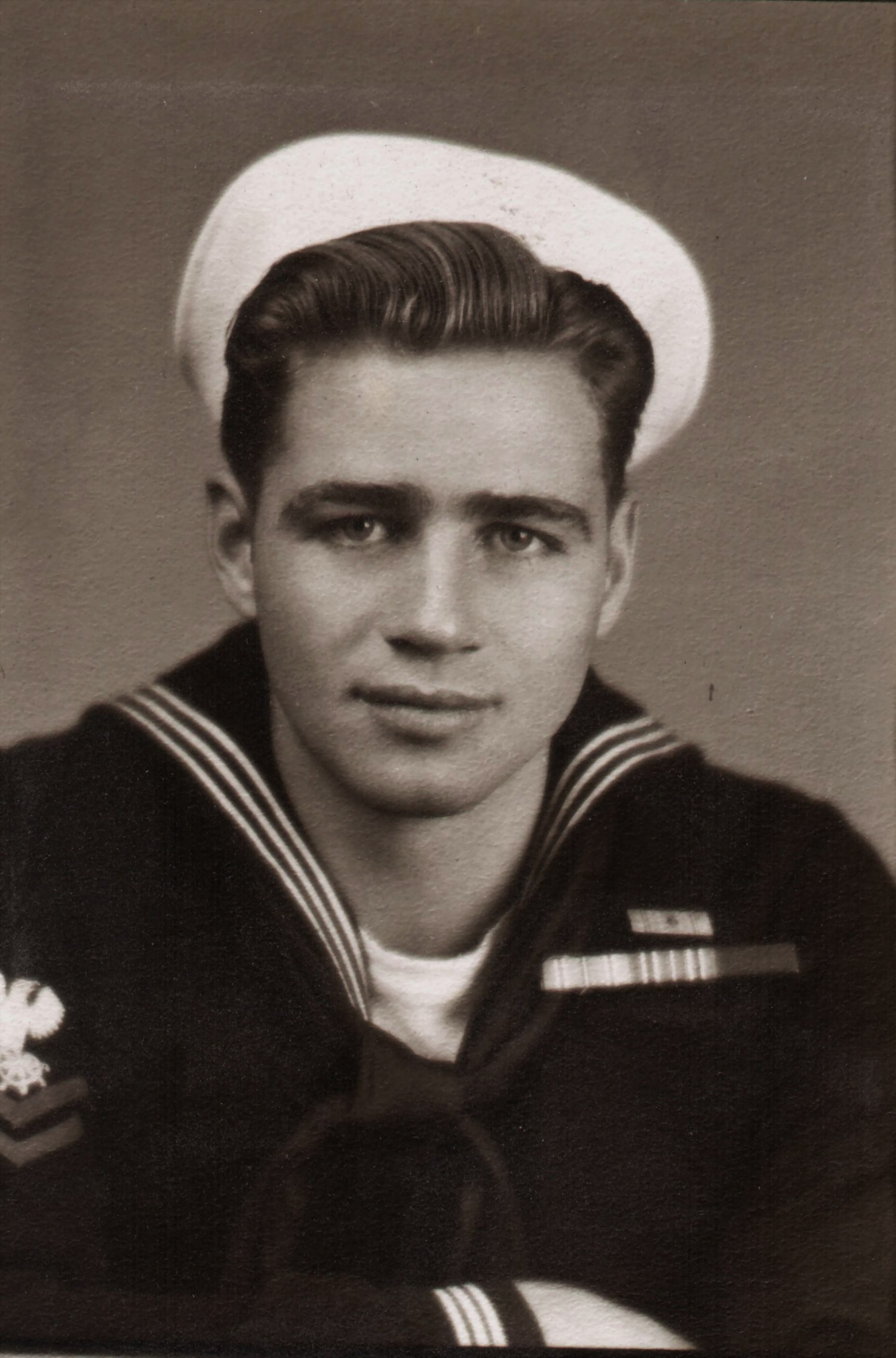
This is a short history of Rulon Jensen Alder's service in the Navy during World War II, written by me, Ronald Paul Alder, his son. Before his death, June 24, 2015; I had several conversations with dad about his service in the war. My brother David interviewed dad about his service and recorded the conversation.[1] The information for this history comes from these conversations and my research on the internet.
The Navy kept meticulous records during World War II, and a lot of it can be found on the internet. I was able to find pictures of the ships dad served on. I showed dad the pictures and he loved looking at them. The pictures brought back lots of memories for him. When I showed him a picture of the USS Trenton, he said, "I liked serving on the Trenton" and added, "yes, that's the Trenton, it's carrying two airplanes." I gave him a disbelieving look. The USS Trenton was a light cruiser, not an aircraft carrier. Dad quickly pointed to the picture and said, see. After closer examination, sure enough, dad was pointing to two airplanes that looked uncomfortably crammed onto the ship. More about these planes later.
After this experience with dad I was motivated to find out more about dad's service in the Navy and his experience in World War II. Over time, I have found a lot about the ships dad served on and have been able to connect these details to the stories dad told. Dad did not talk much about the war. He would talk about the Navy and liked to do so, but it seemed to me that there were things that he preferred to leave unsaid. I found dad's stories and the history of the ships very interesting. I hope family and friends find it interesting as well.
I'll start the story with a little background. Rulon Jensen Alder was born in Preston, Idaho on September 28, 1922 to Melvin Paull Alder and Christella Jensen Alder. Rulon has one older brother Melvin Dean Alder born October 29, 1920 who when by Dean. He has one younger brother Dennis Jensen Alder born January 22, 1924 known as DJ. He has two younger sisters, Emma Ellen Alder, born April 16, 1926, who goes by Emma and Stella Mae Alder born October 31, 1932, who goes by Mae. Since Dennis Jensen was called DJ it follows that family and friends called Rulon Jensen, RJ. Dean was born in Fairview, Idaho the others were born in Preston, Idaho.
The family lived in Preston until RJ was 13 Years old. They then moved to Nibley, Utah which is located south of Logan in Cache county. There they purchased a farm. This was the time of the Great Depression and was financially hard for most people. As it turned out, it was not a good time to start a new farm. They ended up loosing the farm and moved to nearby Providence. When RJ was 15 years old, he along with his brothers needed to find employment to help support the family. He said, "you needed to be 16 to join the CCC, so I lied about my age and join the CCC.
The CCC (Civilian Conservation Corps) was a public works relief program part of the New Deal of President Franklin D. Roosevelt. The goal of the CCC was to give young men employment in a time of very high unemployment. The CCC groups lived in camps and worked on public works projects all across the nation. They accomplished many things, including planning three billion trees. One of the camps that RJ lived in was located in Pleasant Grove, Utah. While at that camp, he cleared land that would be covered by the water of Deer Creek reservoir and worked on other soil erosion conservation projects. He remembers walking from the camp in Pleasant Grove to American Fork to see a movie, which is about 7 miles round trip. He looked for the camp site that he lived in some 72 years earlier. As far as he could tell, the camp site was on land that is now part of the Pleasant Grove cemetery. He remembers the camp being next to a cemetery. The cemetery was there at that time, as attested to by the dates on the headstones.
In the summer of 1940 he returned home and got odd jobs from the farmers in the area. As the summer came to an end, so did the work. He and his brothers weren't sure what they were going to do for work, but knew that they needed to find some. RJ's brother Dean got the idea to join the Marines. Dean and RJ went to the Marines' recruiting office in Salt Lake City and had a complete physical examination. RJ passed the physical, but Dean was turned away because of his teeth. So Dean went to the Army and got excepted. I guess his teeth must not have been too bad.
Enlisted
At the same time that his brother Dean enlisted in the Army RJ enlisted in the Navy and subsequently started his Navy service 11 October 1940. His father had been in the Army in World War One, so it seemed natural that he would join the Army. He has never been sure why he chose the Navy, at the time he just didn't like the idea of the Marines or the Army. The Navy required a 6 year commitment while the Army was only 4 years. He said, perhaps it was the Army stories which his dad told about being in the trenches in France during World War One that influenced him. As he looked back at not going into the Marines, he said it was a good decision. Being a Marine turned out to be very dangerous.
This was more than a year before the U.S. entered the war. I asked him if he was motivated to enlist at that time because he thought that the U.S. would soon be pulled into the War, and it was better to enlist than to be drafted. He answered, "Jobs were hard to find and I needed work!" The way he said it left me with the feeling that I really, really did not understand what it was like to live through the depression.
There was a side benefit that RJ got from joining the Navy that he had not anticipated. RJ had not finished High School, so while in the Navy he took advantage of a program that let him finish his High School education while serving in the Navy.
Boot camp was in San Diego, California. While there he was almost kicked out of the Navy for having an irregular heart beat. That would not have been good for him because he needed work! He said, if I had been kicked out of the Navy, I most likely would have joined the Army. The irregular heart beat is something that he had his whole life. One day he said to me its happening again. He had me feel his pulse. It was beating just fine and then would skip a beat. It was a little creepy. He always thought that this condition would, some day, cause him problems and eventually kill him. At age 90 he was still wondering when that was going to happen.
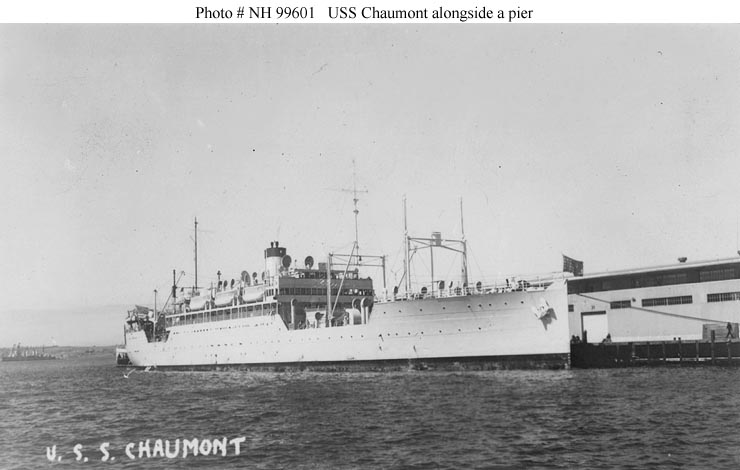
USS Chaumont
After boot camp he was assigned to the USS Trenton which was in Pearl Harbor, Hawaii. To get there he would take a transport ship. He was sent to Vallejo California to board this ship, the USS Chaumont [2]. Unfortunately, the Chaumont was not ready to sail, so he and the other sailors traveling on the ship not only had to wait, they had to paint the ship while they waited. In January 1941, the Chaumont took him to Pearl and his first assignment on the Trenton.
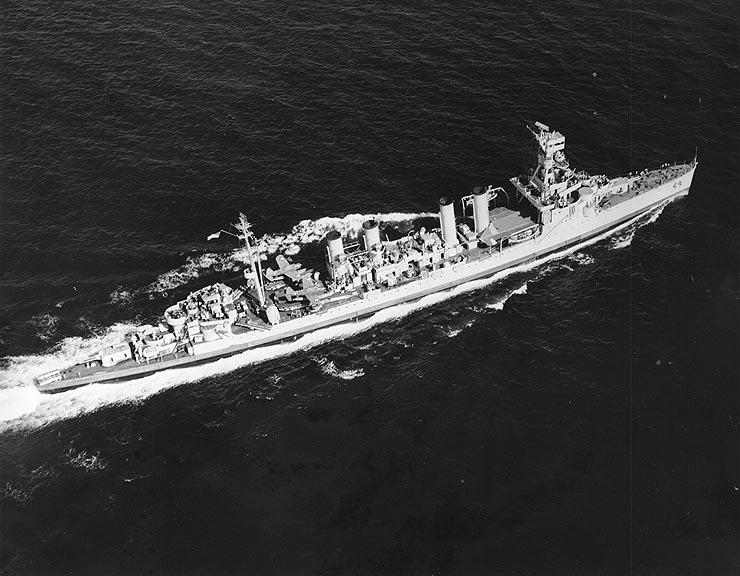
USS Trenton (CL-11) May 1943
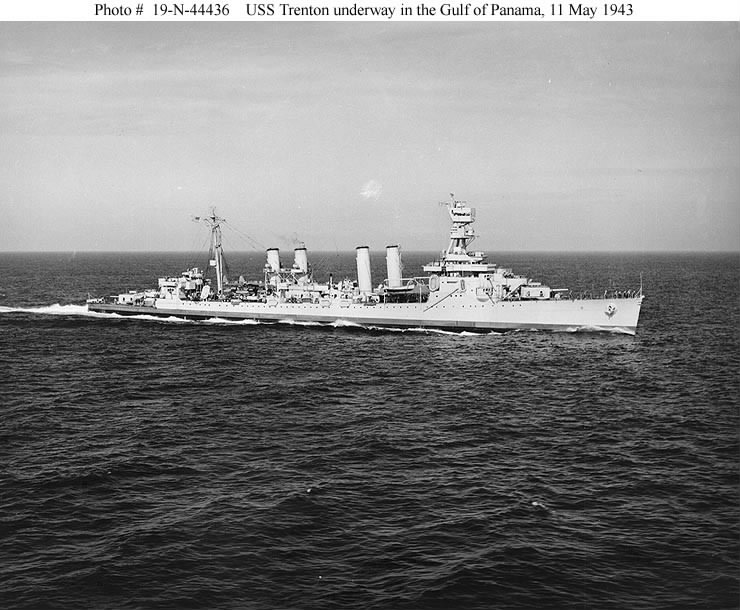
USS Trenton (CL-11) 11 May 1943
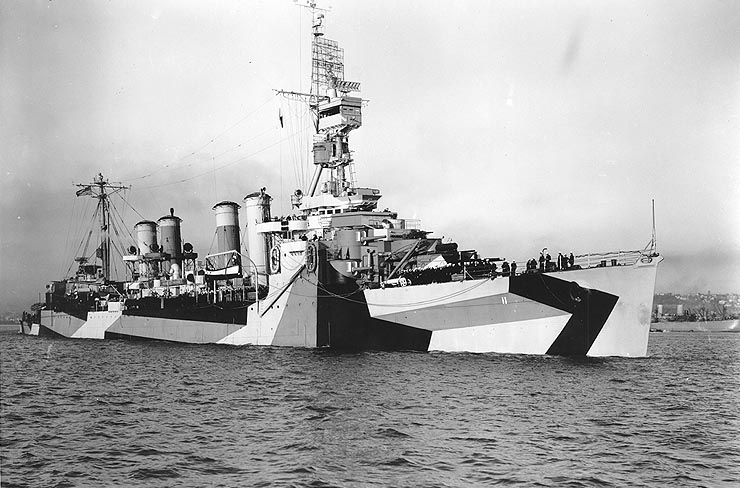
USS Trenton (CL-11) August 1944
USS Trenton [3]
RJ boarded the Trenton at Pearl Harbor on January 24, 1941. The USS Trenton (CL-11) was an Omaha-class light cruiser of the United States Navy. It was the second Navy ship named for the city of Trenton, New Jersey. The Trenton was launched on April 16, 1923. It had many assignments in the Atlantic, Mediterranean, and Pacific before RJ joined her crew in 1941.
Right after joining the Trenton, they were assigned to escort a cargo ship to the Philippines and then return to Pearl Harbor.
On the Trenton he was assigned to be a bugler. The bugler was part of the navigation department or quartermaster department. The bugler was not very appreciated on the ship. Soon RJ learned more and got other assignments. One of them was to keep the quartermaster log.
The Trenton was stationed at Pearl Harbor with the Pacific Fleet. On 28 August 1941 an order was sent to the Commander in Chief Pacific Fleet that included this [4]:
"Destroy surface raiders which attack or threaten Unites States flag shipping. Interpret an approach of surface raiders within the Pacific sector of the Panama Naval Coastal Frontier or the Pacific Southeast sub area as a threat to United States flag shipping. For the present the forces concerned will base Balboa."
In September 1941, as part of this order, the Trenton and other ships were ordered to look for German raiders along the west coast of South America. The orders, which came from President Roosevelt, included authorization to shoot if they find a raider. The other ships that took part in this action were Concord, Richmond, and Warrington.
Merchant raiders[5] were something that Germany used in World War I and again in World War II to disrupt shipping by sinking non-military merchant vessels. The Germans would add armament to a normal merchant ship and conceal the armament making it hard to identify them as a raider.
On Trenton's first trip looking for German Raiders it followed the South American cost to Cape Horn stopping in the most southern city in the world, Punta Arenas. RJ said this about that experience:
"The water is really rough by Cape Horn, I mean really rough. The water is always rough there, but it was really rough then. We just went down, looked for the raider and followed the coast back up to Panama. We stopped in Anafagasta, Chile on our way back We got back to Balboa about November 1941. Balboa Navy Yard was a very large Navy yard by the Panama Canal."
Even though the Trenton got reports of the raider's location along the South American coast they were never able to catch up with the raider.
If the Trenton had not been assigned to look for the German raiders she would have likely been in Pearl Harbor during the Japanese attack. At the time, it looked like leaving Pearl Harbor was leaving security for the possibility of encountering an armed ship. As it turns out, it was very fortunate that the Trenton and RJ were not in Pearl Harbor during the Japanese attack.
It is interesting to speculate what may have happen if the Trenton had found the German raider and had shoot at it as authorized by the President. RJ said the captain of the Trenton was not afraid to use the guns. He recalls a time near Pearl Harbor that his captain saw a ship that he thought was not in the right place, so he fired a warning shot across its bow. That ship quickly changed course. Trenton's assignment to find German raiders was taken very serious by RJ's captain. Had they found the raider, RJ said his captain would have fired on it. This may have gone down in history as the first shot fired by the United States in WWII.
At the time of the Pearl Harbor attack, December 7, 1941, the Trenton was moored at Balboa, Canal Zone. Balboa was operated like a U.S. City. The U.S. had control of the Canal Zone and Balboa Naval Yard. There was a little town there with a place for recreation and a theater. RJ went to a movie in Balboa, and in the middle of the show there was an announcement for all military personal to report back to their ships. Pearl Harbor had been attacked! On the way back to the Trenton, RJ saw great big balloons flying above the canal to protect the canal zone from low-flying aircraft. Back at the Trenton, the scuttlebutt (rumors) was that Trenton would stay and protect the canal. The Trenton was an older ship that needed some changes to prepare it for war. One of the changes was upgraded anti-aircraft guns.
During the early part of 1942, Trenton escorted convoys to Bora Bora in the Society Islands where the Navy was constructing a fuel depot. Bora Bora is several thousand miles from Panama Canal in the middle of the Pacific Ocean. From mid-1942 to mid-1944, the Trenton patrolled the western coast of South America between the Canal Zone and the Strait of Magellan.
At this time there was a lot of uncertainty about South America and the war. It was not sure which side, if any, the countries of South America would take. The Panama Canal was strategically important. Maintaining control of the canal was very important to the U.S.. It seemed likely that there would be some type of military action there. As it turned out, not much in the way of military fighting happened. The Trenton and RJ spent most of the war far from the fighting.
Part of the Trenton's assignment was to escort and support diplomatic missions to the area. The Trenton was designed to be a flagship, so it had quarters for an admiral. These accommodations were converted to host the diplomats they transported. I've always though that having a diplomat showed up to a country in a big war ship had to make a statement.
At the start of the war Chile was not a friend of the U.S. One of their assignments was to cement diplomatic relations with Chile. By the end of the war Chile was friendly with the U.S.
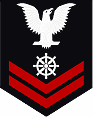
Quartermaster
2nd Class
2nd Class
RJ said this about the time he served on the Trenton:
"I started out as Seaman, and then you automatically get Seaman first class and then you have to choose and I choose to be quartermaster. The quartermaster takes care of the navigation things. There are three steps in quartermaster."
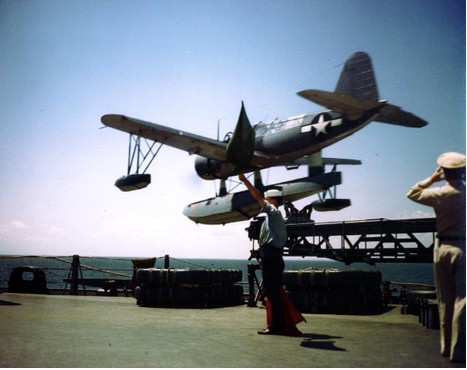
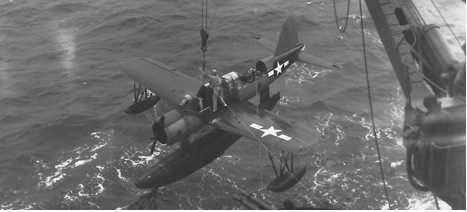
An interesting thing about the Trenton is the two airplanes that it carried. They can be seen in the first picture of the Trenton if you look careful. The planes were used for reconnaissance. As you can see, there is no runway on the ship. The planes are pontoon planes that were catapulted into the air and would land in the water. To make the landing easier, the ship would turn, leaving smother water to the side of the ship. A crane would lift them back onto the ship. The airplane pictures were not taken on the Trenton, but do show similar planes being catapulted from a ship and recovered using a crane. I read an account of one of their uses. In this account, they flew 150 miles ahead to see what was there. Reading this account gave me the impression that they were used more than I had first thought.
One of RJ's responsibilities on the Trenton was the sail locker. The ship was not sail powered. The sail locker, in the olden days, was indeed the place that sails were stored. The sail locker is a catch phrase for the location that stored awnings, flags and other related Items. They used these flags for signaling. The flags had all kinds of meanings. There is a flag indicating a diver in the water. One indicated they wanted to talk to you. There was one indicating, I am on fire and have dangerous cargo; keep clear. The sail locker had a sewing machine to maintain the flags. RJ taught himself to sew. He even made a flag of Chile.
Here is a side story that is related to dad being a quartermaster and having responsibilities for ship navigation. When GPS (Global Positioning System) devices started to be popular, I told dad this device can tell you your location within 20 feet anywhere in the world. He was very sceptical. He thought that it may be possible, but not something everyone could afford. It took him a long time, but he excepted that GPS devices were real.
He told me that in the 1940s, navigation was very different. They used celestial navigation. If clouds block their view of the sky they would use dead reckoning to track their location. This meant they would calculate their location from the speed and direction of the ship. This was not very accurate over a long distance. Finding Hawaii after a long period of cloud cover was not easy. Because of the curvature of the earth, the horizon is only 4 miles away. If you are in a tower, say the 'crow's nest' of a ship, you can see another ship about 20 miles away. During a long trip to Hawaii with cloud cover, you could be more than 20 miles off course. Clouds covering the tall mountains of Hawaii may be enough for you to sail right past.
RJ served on the Trenton over three years until his transfer 29 March 1944. He spoke very fondly of the Trenton. After he left the Trenton it was overhauled for the last time. The second picture of the Trenton is after this overhaul.
_underway_off_the_Philadelphia_Naval_Shipyard_on_25_June_1943_(NH_96628).jpg)
Transport USS Antaeus (AS-21/AG-67)
He was transferred to a naval station on Long Island, New York, a land assignment. To get there, he traveled on the USS Antaeus (AS-21/AG-67). She was a commercial passenger liner acquired by the Navy. She first served as a transport ship and later was converted to a hospital ship.
After his assignment at the Long Island substation training center he was assigned to a substation training center in Miami Florida. This center was interesting to him because it was not a regular base, but had been maked by simply taking over hotels and a good size garage used as a cafeteria. There he trained on small ships.
He was then assigned to the USS Tunica (ATA 178) which was being built in Galveston, Texas. He traveled to Galveston and served there until the ship was ready to sail. The Tunica was a sea-going tug and support vessel. The ship's first assignment was to pickup two barges at New Orleans, Louisiana for towing to Hawaii. It transited the Panama Canal, stopped in San Diego, California and reached Pearl Harbor on December 10, 1944. During the time RJ spent on the Tunica it had not been given its name and was only known as ATA 178. After getting to Pearl Harbor he was assigned to a tug named the USS Gear.
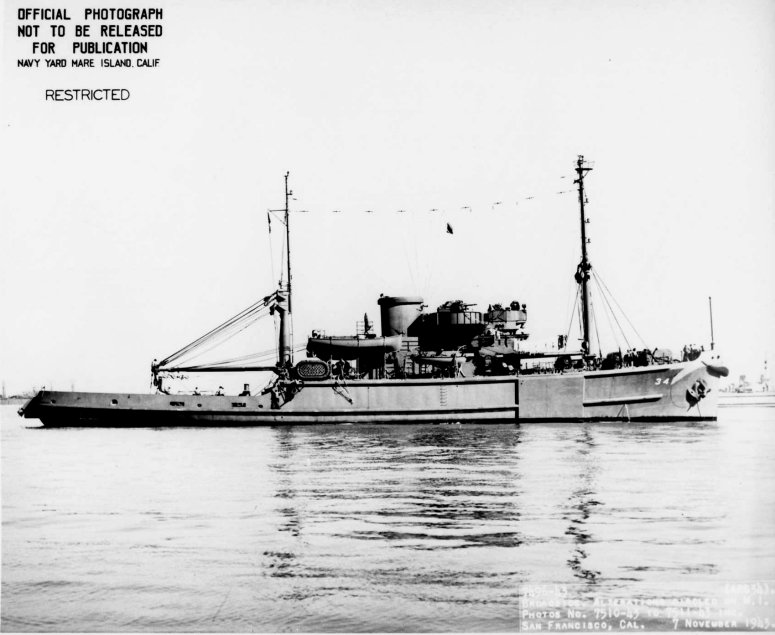
USS Gear (ARS-34) November 1945
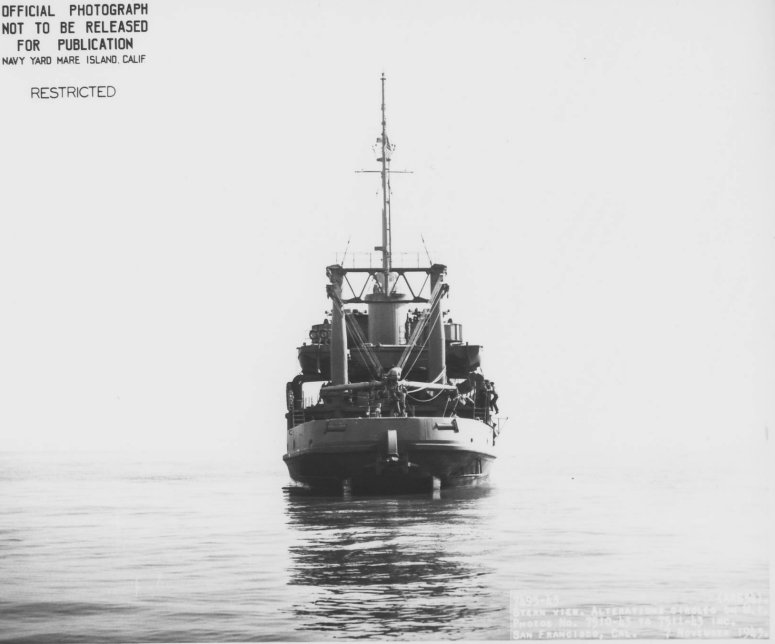
USS Gear (ARS-34) November 1945
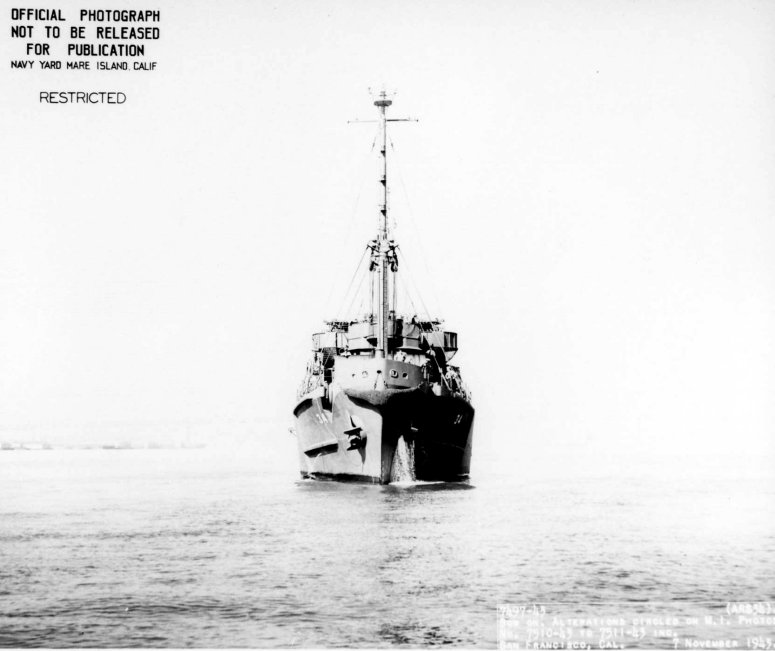 USS Gear (ARS-34) November 1945
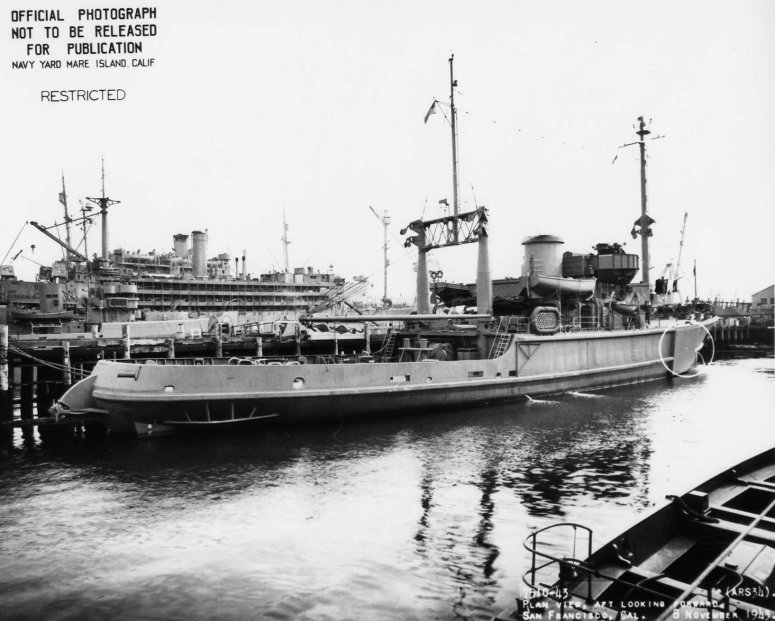
USS Gear (ARS-34) November 1945
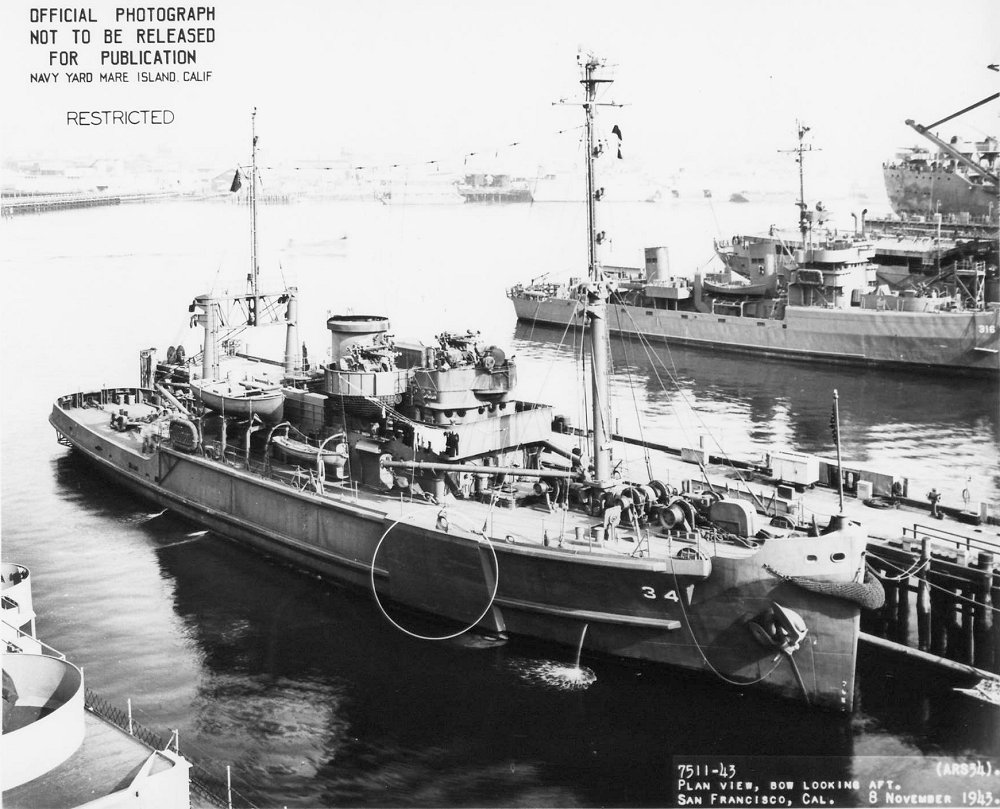
USS Gear (ARS-34) November 1945
USS Gear [6][7]
The USS Gear (ARS-34) was a Diver-class rescue and salvage ship. Her task was to come to the aid of stricken vessels.
As a side note, I have seen the Gear. As a teenager, I vacationed with my family in San Diego. My dad got "a bright idea", one of his favorite expressions, to go to the docks and look at the ships. This most certainly was not the first or last time he got this "bright idea". So, we all humored dad and went on an explore to find ships. We found lots of boats to look at, and they were interesting. Then we found the Gear. At first dad had a hard time believing it was the same ship he served on over 25 years earlier. On the back of the ship in faded paint was printed "Gear". The more dad looked, the more he was convinced it was in fact the Gear. At this point in time, is was not owned or operated by the Navy. Records show that it was around until 1981 when it was sold for scrap. I was very interesting to see a ship that was part of dad's war stories. Dad didn't talk much about the war. He talked a lot about the Gear that day, but even then, he seemed to hold back. He had a lot of good memories from the war that he wanted to hold on to, and at the same time there was much that he simply wanted to leave behind.
Fortunately for RJ none of the potential hostilities along the western side of South and Central America ever materialized. For most of the war he saw little or no fighting action. After being assigned to the Gear, things were about to change for RJ.
In 1944 while on the Gear he had several assignments in the Pacific including support operations at Saipan and Tinian. Then in January 1945 he was part of an amphibious assault force bound for Iwo Jima, the site of some of the most terrible and bloody fighting in the war. Many lost their lives there on both sides of the fighting.
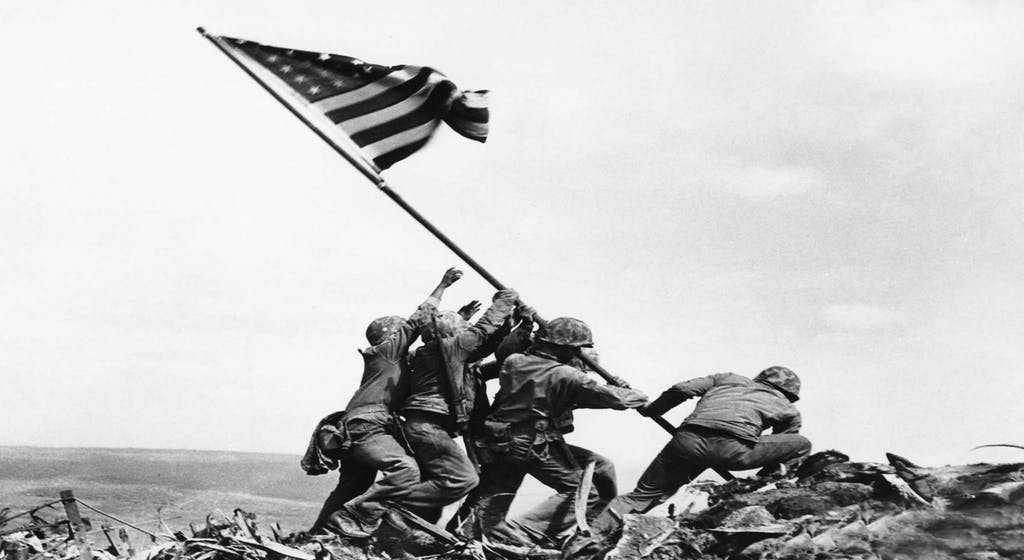
Iwo Jima Flag Raising
Iwo Jima
RJ on the Gear arrived in the outer transport area of Iwo Jima on February 19, 1945, to witness the landing of U.S. Marines under cover of intensive naval gunfire and air attack. The Gear proved invaluable in assisting the ships of the fleet, pumping out flooded spaces, making ship repairs and performing various towing assignments.
This is what dad had to say about the Iwo Jima invasion.
"We left Pearl Harbor for a base in the Philippines. The Philippines was just a waiting spot to prepare for the Iwo Jima invasion. The duties of the Gear were to do any necessary repairs to ships. We traveled from the Philippines to Iwo Jima with four to six transport ships and four or five personnel ships and had a couple of destroyers as escorts. We arrived a few hours after the landing had started. We went right by the beach, close to where the flag would go up, to help a ship in trouble. We got pretty close; with a pair of binoculars I could see what was happening on the shore. I could see the raids. I sat there and watched them for a while with a pair of binoculars. I saw the flamethrowers flushing out the troops. There was a ship that had mechanical problems, and we were going to pull it out, but it ended up getting itself out. There were ships from many places arriving all at the same time. When I looked around, there were ships everywhere. They surrounded the whole Island."
The Gear returned to Saipan on March 5th with an LSM and two LCI's in tow.
Okinawa
Four days later the Gear and RJ were en route with a transport assault force that arrived off Okinawa on April 1st, D-day of the invasion. Here the Gear braved the day and night aerial onslaughts in a busy schedule of battle damage repairs to ships like the Wichita (CA-45), England (DE-635), Aaron Ward (DD-483), and Ingraham (DD-694).
This is what RJ had to say about the Okinawa invasion;
"While I was at Okinawa I saw a plane fly right over, I mean close, it was not very high. It was a Courseair. There was a whole row of LSTs that had dropped off troops. The LSTs were shooting at the airplane they thought was Japanese. It was a U.S. plane and one or two of the shots ended up hitting the aerial on our ship. The Courseair was trying to land at the airstrip they had just taken over. The plane went behind some trees and disappeared, so I didn't see if it had gotten hit. They established a base in Okinawa, and they pretty much had the island captured. We stayed at Okinawa for several days. There were all kinds of ships there, hospital ships and cargo ships. Right after dark, when it was clear, kamikazes would come over and dive at the destroyers that were enforcing the 60-mile perimeter around the island. One evening after they had established the base I saw a kamikaze fly right over the base and crash into a hospital ship."
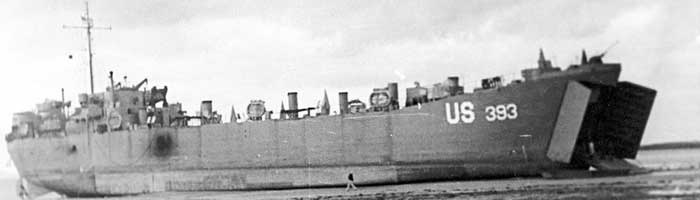
LST Landing Ship, Tank
The Landing Ship, Tank (LST) is an ocean-going ship capable of shore to shore delivery of tanks, amphibious assault vehicles, and troops.
The Battle of Okinawa was fought on the Ryukyu Islands of Okinawa and was the largest amphibious assault in the Pacific of World War II.
The Gear departed Okinawa on 15 May for repair service at Ulithi (21 May - 12 June), then proceeded via Eniwetok with two tank landing ships in tow for Pearl Harbor, arriving 6 July 1945. The Gear then went to Long Beach, California. The war ended August 14, 1945. RJ had not served out his enlistment time, so he did not get to go home at the end of the war. His next transfer was 14 September 1945 to the USS Epping Forest.
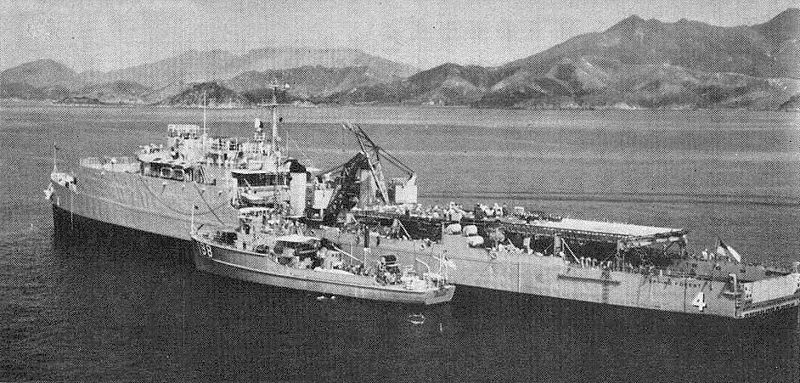
USS Epping Forrest (LSD-4)
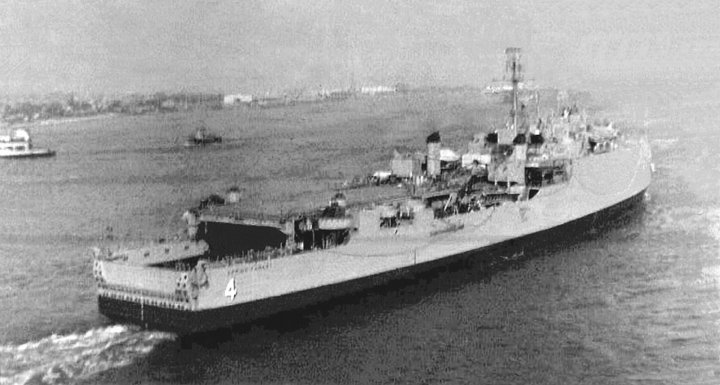
USS Epping Forrest (LSD-4)
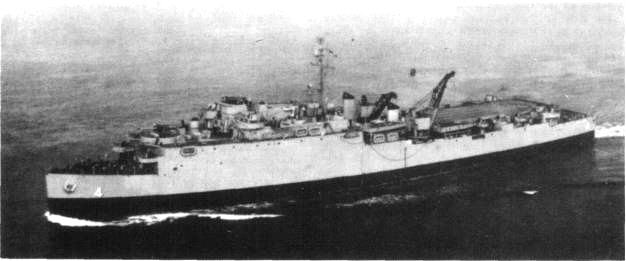
USS Epping Forrest (LSD-4)
USS Epping Forrest
RJ boarded the Epping Forest in Portland Oregon. USS Epping Forest (LSD-4) was an Ashland-class dock landing ship acquired by the U.S. Navy during World War II for duty in the Pacific Theater. Her task was to carry amphibious landing craft and equipment. She helped with recovery and repair of troop landing craft. Named for an estate in Lancaster County, Virginia where Mary Ball Washington, mother of George Washington, was born. She was the only U.S. Naval vessel to bear the name.
Bikini Atoll
While on the Epping Forrest, RJ participated in Operation Crossroads, the atomic weapons tests done at Bikini Atoll in 1946. The Epping Forrest carried a load of small crafts that were used in the tests. The crafts were placed in the very large lagoon of Bikini Atoll, and then two atomic bombs were detonated to determine how much damage would be done to the crafts. Fortunately for him, RJ was a long way from Bikini Atoll when the bombs went off.
RJ tells an interesting story about his part in the atomic weapons tests. The Epping Forrest was a sea going dry dock. It was capable of loading smaller craft into the back section and lifting them out of the water to repair them. The Epping Forrest carried craft in this dry dock to the test site. RJ said that one of the craft they transported was carrying the atomic weapon used in the test. I have heard RJ (my dad) tell this story several times. According to him, his ship was entrusted to transport the bomb used in the test. I have tried to confirm this on the internet without any success.
As a side note, the atomic tests make Bikini Island very famous. Bikini Island is one of the many small islands that make up Bikini Atoll. The bikini swimsuit was named because of the atomic tests at Bikini Island.
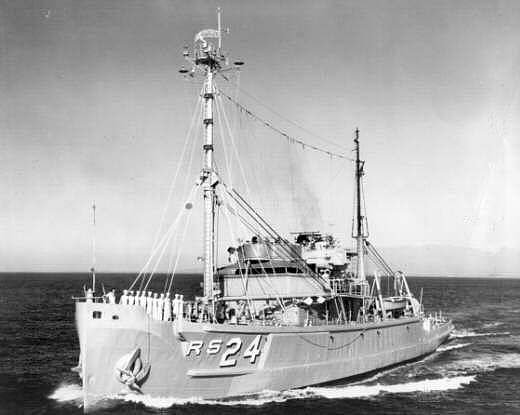
USS Grasp (ARS-24)
USS Grasp
RJ boarded the USS Grasp (ARS-24) August 9, 1946. He served on this ship until it was decommissioned December 1946. This also concluded RJ's six-year enlistment, and he was discharged from the Navy December 24, 1946.
Final Note
RJ lived a long live.
He died June 24, 2015 in Orem, Utah at the age of 92.
His service in the Navy influenced the rest of his life.
He always loved boats and the water.
Just sitting in a boat bouncing on the waves made him happy.
Muster Rolls
As I have already mentioned the Navy keeps very meticulous records. Recently I found many records on Fold3.com relating to my dad's service. Two types of records were particularly interesting to me, Muster Rolls and Report of Changes. Muster Rolls list everyone on the ship and were filed quarterly. Report of Changes shows when someone is received on board, transferred off, or has a changed in rating.


